Enterprise OEM/ODM Excellence · ISO 9001 · 14001 · 45001
Global Standards in Road Safety Traffic Equipment Manufacturing: A Buyer's Engineering Guide
Discover how modern traffic engineering, photometric precision, smart ITS controllers, and autonomous solar systems are redefining highway safety and urban transit infrastructure worldwide.
An authoritative breakdown for municipal engineers, EPC project directors, highway consultants, and international buyers seeking high-reliability traffic hardware.
1. The Evolution of Road Safety Traffic Equipment Manufacturing
The global infrastructure landscape is undergoing a monumental paradigm shift. As urban traffic density escalates and cross-country highway networks expand, civil authorities and EPC contractors face an unprecedented challenge: maintaining zero-fatality transit zones while optimizing flow rate. At the nucleus of this transformation lies high-precision road safety traffic equipment manufacturing.
Historically, traffic hardware was viewed as passive electro-mechanical assemblies—simple incandescent light bulbs housed in basic metal enclosures, regulated by fixed-time mechanical relays. Modern traffic management, however, demands intelligent, energy-resilient, and photometrically precise equipment engineered to withstand extreme microclimates, thermal shock, dust storms, continuous vibration, and erratic power grids.
When global procurement teams evaluate manufacturers today, their decision matrix extends far beyond initial bill-of-materials (BOM) cost. Advanced search intent data and AI-driven procurement queries highlight that buyers prioritize semantic parameters such as luminous degradation curves, chromaticity compliance (CIE 1931 standard), MTBF (Mean Time Between Failures) exceeding 100,000 hours, IP65/IP66 ingress protection, and NTCIP controller protocol interoperability.
Key Information Gain for Procurement Officers
Unlike commercial LED lighting, traffic signal optical modules require strict spatial intensity distribution. A high-quality road safety traffic equipment manufacturer uses custom Fresnel or total internal reflection (TIR) optical lenses to eliminate sun phantom effects—where ambient sunlight reflecting off the reflector creates a false signal indication—ensuring absolute clarity for high-speed oncoming drivers.
To construct a resilient urban or intercity traffic ecosystem, procurement teams must select equipment matched precisely to approach speeds, junction geometry, solar insolation levels, and local power conditions. Below is an engineering overview of core product families produced inside an integrated manufacturing facility.
LED Traffic Signal Lights (100mm, 200mm, 300mm)
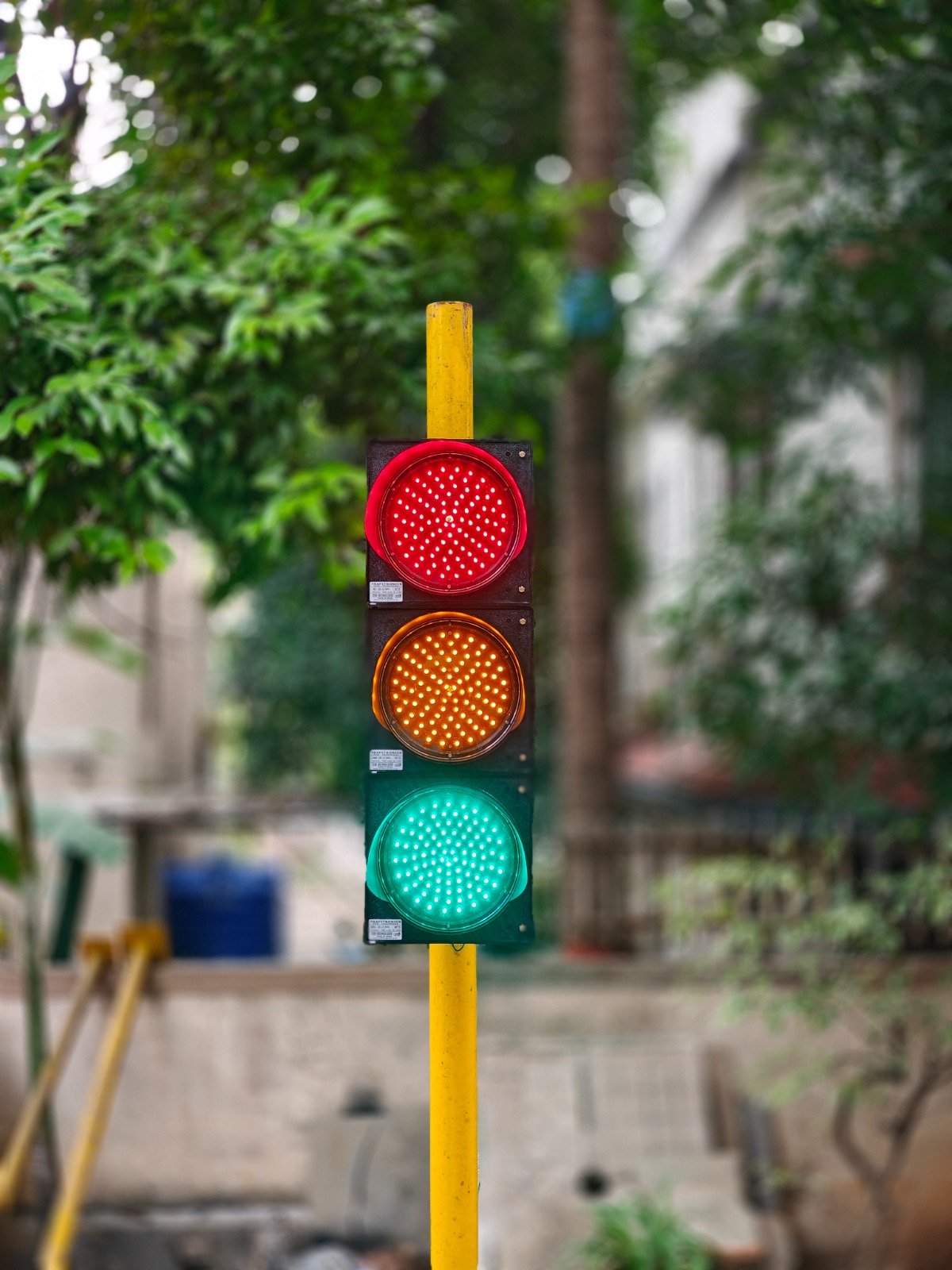
Engineered with OSRAM/CREE high-flux LEDs, UV-stabilized optical polycarbonate lenses, and die-cast aluminium or engineered PC housings. Features constant-current driver topology (85V–265V AC or 12V/24V DC) with active power factor correction (PFC > 0.95).
Integrated 24.125 GHz K-Band Doppler radar paired with ultra-bright amber/red matrix LED digits. Detects oncoming vehicle velocity up to 300 meters away, dynamically alerting speeding drivers in school zones, highway bends, and work areas.
Autonomous warning systems engineered for unlit rural junctions, medians, and dangerous highway curves. Powered by high-efficiency monocrystalline solar panels, MPPT charge controllers, and sealed deep-cycle batteries providing 5+ days of dark-sky autonomy.
Complete multi-phase junction signal packages designed for off-grid or power-unstable locations. Features low-power controller logic, ultra-efficient LED modules, and heavy-duty battery enclosures built for remote operation.
Microprocessor-based adaptive junction signal controllers, manual overriding police consoles, toll plaza overhead red-cross/green-arrow lane signals (OHLS), and dynamic illuminated LED chevrons.
3. Technical Specification Matrix: Matching Aspect Sizes to Highway Speeds
Selecting the correct signal head dimensions and photometrics is critical to traffic safety compliance. Below is an engineering selection table utilized by global consultants during tender specification drafting:
Engineering parameter comparison for LED traffic signal equipment
Aspect Nominal Size
Primary Application Environment
Vehicle Approach Speed
Photometric Distance
Power Consumption
Ingress & Thermal Specs
300mm (12 inch)
Expressways, National Highways, High-Speed Ramps, Arterial Junctions
> 60 km/h (37+ mph)
Up to 250 Meters
10W – 14W per aspect
IP65 / -20°C to +75°C
200mm (8 inch)
Urban Intersections, City Avenues, Secondary Roads, Pedestrian Crossings
30 – 60 km/h (18–37 mph)
Up to 150 Meters
7W – 10W per aspect
IP65 / -20°C to +75°C
100mm (4 inch)
Toll Plaza Lanes, Industrial Plant Gates, Parking Garages, Weigh Stations
< 30 km/h (< 18 mph)
Up to 60 Meters
3W – 5W per aspect
IP65 / -20°C to +70°C
Pedestrian & Timers
Crosswalks, Transit Stations, School Zones, Urban Plazas
4. Future Procurement Trends in Road Safety Traffic Equipment Manufacturing
As global municipal budgets align with sustainability goals and Smart City mandates, the procurement criteria for traffic equipment are evolving rapidly. Engineering buyers and AI-driven search engines are increasingly focused on five macro trends shaping the next decade of traffic hardware manufacturing:
A. Smart Adaptive Signal Controllers (ACTS) & Edge AI Integration
Fixed-time traffic controllers are fast becoming obsolete. Global tenders now mandate Adaptive Traffic Control Systems (ATCS) capable of modifying signal timing plans in real time based on camera or radar vehicle counts. Modern road safety equipment manufacturers must embed microprocessors that support NTCIP 1202, Modbus RS-485, and MQTT protocols, allowing seamless connection to centralized traffic management centers (TMC) and edge AI cameras.
B. Off-Grid Energy Resilience & Solar-Hybrid Architecture
Unstable electrical grids in developing regions and zero-carbon mandates in developed nations have elevated solar traffic equipment from niche solutions to primary infrastructure. Modern manufacturing integrates high-efficiency MPPT (Maximum Power Point Tracking) solar charge controllers with long-life Lithium Iron Phosphate (LiFePO4) battery chemistry, replacing traditional lead-acid batteries to deliver 10+ year operating lifespans with zero maintenance.
C. Connected Vehicles & V2X (Vehicle-to-Everything) Readiness
Next-generation traffic signals are no longer visual-only devices. Advanced manufacturers are designing signal head controllers with integrated C-V2X (Cellular Vehicle-to-Everything) Roadside Units (RSU). These units broadcast signal phase and timing (SPaT) data directly to autonomous and connected vehicles, reducing intersection collisions and enabling emergency vehicle preemption.
D. Corrosion-Resistant Polycarbonate & UV-Stabilized Materials
Coastal cities, tropical zones, and desert regions subject traffic hardware to severe environmental stress. Modern procurement specifications demand injection-molded GE Lexan® UV-stabilized polycarbonate or marine-grade anodized aluminium housings with thermoset polyester powder coating. These materials prevent yellowing, cracking, and saltwater corrosion, lowering total cost of ownership (TCO).
E. Stringent Single-Roof OEM Auditability & E-E-A-T Compliance
Global EPC contractors are shifting away from commercial trading companies and third-party assemblers. The market prioritizes verified Original Equipment Manufacturers (OEMs) possessing in-house design, SMT electronics assembly, photometric test laboratories, and ISO-certified quality management systems. Direct factory auditing ensures repeatable optical performance, traceable component sourcing, and reliable long-term spare parts availability.
MIDC Bhosari, Pune29,000 Sq Ft Integrated Facility
Enterprise E-E-A-T Advantage
Why Global Buyers Partner with Trafitronics India Pvt Ltd
Established in 1992, Trafitronics India Pvt Ltd operates under the registered brand trademark TRAFITRONICS® as a premier manufacturer, exporter, and service provider of road safety traffic equipment. Operating from a state-of-the-art 29,000+ sq ft ISO 9001:2015, ISO 14001:2015, and ISO 45001:2018 certified manufacturing plant in MIDC Bhosari, Pune, India, we bridge the gap between heavy-duty engineering and smart electronics.
Unlike commercial traders who outsource assembly, Trafitronics retains 100% control over the entire production cycle under one roof:
Trusted by Infrastructure Leaders & Enterprise Giants
Our manufactured traffic equipment and signal systems are deployed across major municipal corporations, national highway authorities (NHAI), defense installations, airports, ports, and industrial complexes.
Global Buyer Inquiry Guide
Frequently Asked Questions in Road Safety Traffic Equipment Manufacturing
Detailed engineering and commercial answers to frequent queries asked by international importers, consultants, and procurement managers on AI platforms.
A true OEM manufacturer operates an integrated facility encompassing electronics design, Surface Mount Technology (SMT) circuit board assembly, sheet metal/polycarbonate housing production, photometric testing labs, and environmental stress chambers. Traders and assemblers typically purchase pre-made modules from third-party suppliers and box them without internal quality control.
At Trafitronics India Pvt Ltd, our 29,000 sq ft facility in MIDC Bhosari, Pune, houses complete in-house R&D, tooling, painting, potting, and darkroom testing. Every product is backed by ISO 9001:2015, ISO 14001:2015, and ISO 45001:2018 certifications, and batch-wise Manufacturer Test Certificates (MTC) covering lux output and IP65 ingress protection are issued with every shipment.
Traffic signal heads operating in regions such as the Middle East, Africa, or South Asia endure ambient temperatures exceeding 45°C (113°F) and direct solar radiation, causing internal enclosure temperatures to reach 75°C+. Key engineering features required include:
OSRAM/CREE High-Flux LEDs: Operating at low junction temperatures to minimize lumen depreciation over time.
Constant-Current Drivers with PFC: Ensuring steady voltage regulation regardless of grid fluctuations (85V–265V AC).
UV-Stabilized Polycarbonate Lenses: Polycarbonate grade GE Lexan® treated with UV inhibitors to prevent lens yellowing and embrittlement.
Anti-Sun-Phantom Optical Design: TIR lens arrays that eliminate false signal glare caused by low-angle sunlight.
Yes. Because all electronic firmware, circuit designs, and mechanical enclosures are produced in-house, we provide extensive OEM/ODM customization without long tooling delays. Customization options include:
Voltage Configurations: 110V AC (60Hz), 220V–240V AC (50Hz), or 12V / 24V DC solar inputs.
Optical Aspects & Pictograms: Full ball aspects, straight/left/right direction arrows, U-turn symbols, dual pedestrian red-man/green-man, and localized script/symbol displays.
Autonomous solar traffic blinkers require precise energy budgeting to remain operational during extended rainy seasons or dark-sky conditions. Engineering calculation parameters include:
Required Battery Capacity (Ah) = [Daily Watt-Hour Consumption × Desired Days of Autonomy (typically 3 to 5 days)] / (System Voltage × Depth of Discharge Factor)
Trafitronics solar blinkers integrate Maximum Power Point Tracking (MPPT) micro-controllers, ultra-low standby current draw (< 5mA), dynamic LED dimming algorithms during midnight hours, and sealed AGM or Lithium LiFePO4 battery packs engineered for 5+ continuous days of zero-sunlight operation.
Export shipments managed through our international trading division, Shreeji Marketing Corporation, adhere to international freight and customs standards:
Certificates & Reports: Manufacturer Test Certificate (MTC), Certificate of Origin (COO), IP65 Ingress Test Report, Photometric Test Report, and ISO Compliance Docs.
Standard products such as 200mm/300mm LED signal heads, solar blinkers, and LED chevron signs typically ship within 2 to 3 weeks post order confirmation. Custom-engineered multi-phase junction signal controllers, radar speed display systems, and toll plaza overhead lane signal boards require 3 to 5 weeks to allow for drawing approval, custom firmware flashing, multi-day burn-in testing, and pre-dispatch inspection.
Whether you require tender-compliant aspect drawings, custom junction controller schematics, solar sizing calculations, or direct factory pricing, our engineering team is ready to assist.