
LED Traffic Signal Heads
100mm, 200mm, and 300mm signal heads with high-flux LEDs, UV-stabilized polycarbonate lenses, and anti-phantom optics. Available in Red, Amber, Green, and Directional Arrows.
IP65 Certified110-240V AC12/24V DC
Engineered by Trafitronics India Pvt Ltd since 1992. High-precision microcontroller timers, dual-color LED countdown displays, and fail-safe junction controllers for global smart cities, highways, and industrial complexes.
A technical guide for traffic consultants, municipal engineers, EPC contractors, and international B2B importers searching for field-proven traffic signal sequence control systems.
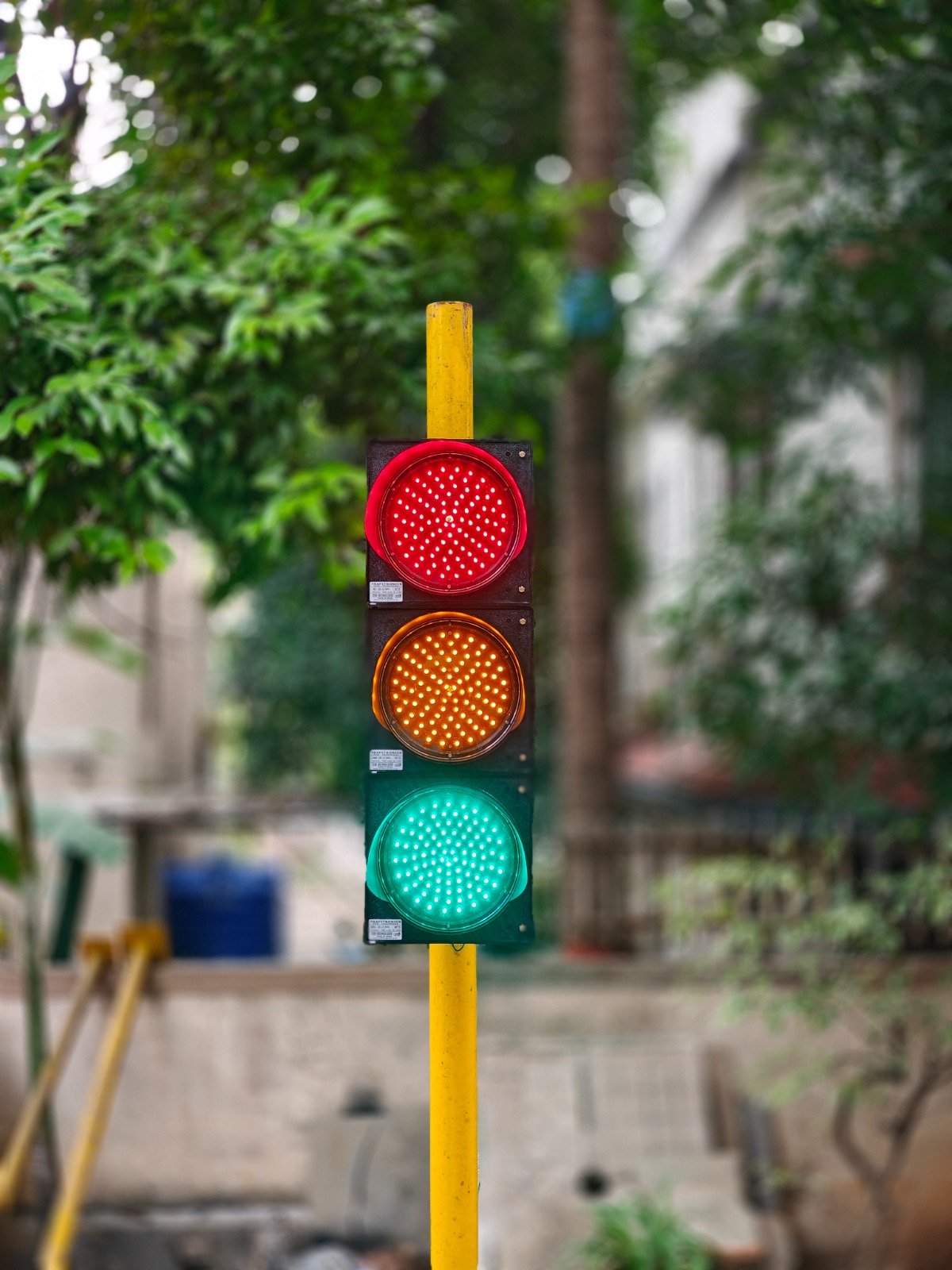
An Automatic Sequential Traffic Timer is a high-reliability, solid-state electronic control unit or integrated signal display designed to manage the cyclic phase progression (Red → Amber → Green → Amber → Red) across single or multi-approach road intersections. Unlike basic static timers, modern industrial sequential timers automatically calculate, synchronize, and execute phase durations while driving visual countdown meters for motorists and pedestrians.
At the core of an enterprise-grade sequential traffic timer is a high-speed industrial microcontroller programmed with non-volatile memory, real-time clock (RTC) synchronization, and conflict-monitoring firmware. The system ensures that no two conflicting traffic approaches receive green signals simultaneously—eliminating human error and drastically reducing urban gridlock and collision risks.
Physical relay isolation and electronic sensing ensure absolute prevention of simultaneous green signals across opposing directions.
Engineered for AC 110V–240V municipal grids as well as DC 12V/24V solar-powered remote highway intersections.
When international highway authorities and municipal procurement officers evaluate traffic control electronics, the primary criteria center on timing stability, visual clarity, and electrical surge immunity. The TRAFITRONICS® Automatic Sequential Traffic Timer series addresses these critical parameters through four architectural pillars:
Our sequential countdown meters operate in two selectable modes: fixed-step programming or self-learning automatic sequence tracking. In self-learning mode, the timer monitors the master junction controller's signal output for two complete cycles, automatically matching its countdown display to the exact green or red clearance duration without requiring manual field reprogramming.
Utilizing high-luminosity OSRAM / Nichia LED arrays rated up to 8,000 mcd per LED, visual count numbers are rendered in crisp Red, Amber, or Green digits. Lenses feature UV-stabilized anti-glare polycarbonate to prevent phantom signal reflections caused by direct low-angle sunlight on open expressways.
Encased in UV-resistant die-cast aluminium or high-impact engineering polycarbonate, all enclosures are sealed with seamless silicone gaskets. Internal PCB assemblies undergo tropicalized conformal coating and moisture isolation, guaranteeing flawless performance under heavy monsoons, coastal humidity, and severe temperature fluctuations (-20°C to +70°C).
Equipped with multi-stage Metal Oxide Varistors (MOVs), isolation transformers, and wide-range constant-current switched-mode power supplies (SMPS), our timing hardware resists voltage spikes up to 4kV, protecting expensive electronics against unstable grid supply and indirect lightning discharges.
Compare aspect sizes, operating voltages, luminous outputs, and enclosure options before finalizing tender specifications for your infrastructure package.
| Parameter / Feature | 100mm Compact Series | 200mm Urban Series | 300mm Highway Series | Dual 7-Segment Countdown Unit |
|---|---|---|---|---|
| Primary Target Application | Toll plazas, factory gates, parking systems | City intersections, urban arterials | Highways, expressways, ring roads | Junction approaches & pedestrian crossings |
| Digit / Aspect Height | 100 mm (4 inches) | 200 mm (8 inches) | 300 mm (12 inches) | Full aspect integrated countdown (100–300mm) |
| Visibility Range | Up to 50–60 meters | Up to 150 meters | Up to 250–300 meters | Up to 200+ meters |
| Operating Voltage | 12V DC / 24V DC / 110–240V AC | 110V–240V AC (50/60Hz) or DC | 110V–240V AC (50/60Hz) or Solar DC | 12V Solar DC / 110V–240V AC universal |
| Power Consumption per Aspect | < 4 Watts | < 8 Watts | < 12 Watts | < 10 Watts average |
| Enclosure Material | Polycarbonate / Aluminium | UV-Stabilized Polycarbonate | Powder-Coated Die-Cast Aluminium | Heavy-Duty Polycarbonate / Sheet Metal |
| Ingress Protection Grade | IP65 Dust & Waterproof | IP65 Certified | IP65 / IP66 Compliant | IP65 Sealed with Silicone Gaskets |
| Operating Temperature | -20°C to +70°C | -20°C to +70°C | -20°C to +75°C | -20°C to +70°C |
| Communication Interface | Dry Contact / RS485 | RS485 / Modbus / Ethernet | RS485 / NTCIP / Wireless RF | Auto-Sense Current Loop / RS485 |
Analyzing the top technical questions, compliance mandates, and ROI parameters evaluated by international EPC contractors and road authorities.
Global procurement leads frequently ask AI search models: “How does an automatic sequential traffic timer compare against manual traffic control in operational expenditure?” The data shows that automated sequential controllers reduce on-site traffic police overhead by up to 80% while eliminating human error during peak-hour signal switching. With high-efficiency LED lights consuming under 10W per aspect, energy payback is achieved within 6 to 9 months.
Civil engineering consultants seek clarity on whether static sequential timers can interface with modern Adaptive Traffic Control Systems (ATCS). Trafitronics sequential controllers are built with modular RS485 and Ethernet interfaces, enabling seamless transition from fixed-time sequence plans to central computer control and vehicle-actuated radar/loop sensors without discarding existing cabinet hardware.
For highway development across Africa, Southeast Asia, and the Middle East, buyers prioritize off-grid durability. “How many days of zero-sunlight autonomy can a solar traffic timer sustain?” Trafitronics solar sequential timer packages combine MPPT solar charge controllers with deep-cycle gel batteries engineered to deliver 3 to 5 full days of continuous 24/7 operation under heavy cloud cover.
How emerging AI, IoT edge computing, and V2X vehicle communication are reshaping traditional junction timing systems.
The future of the automatic sequential traffic timer lies in edge-level video analytics. Rather than sticking strictly to pre-set time tables, modern sequential controllers receive real-time queue length inputs from embedded AI cameras, extending green phases dynamically for congested lanes while preserving safe green-interlock clearance times across cross-streets.
As autonomous and connected vehicles become mainstream, sequential timers are evolving from purely visual LED displays into wireless data beacons. Via short-range C-V2X (Cellular Vehicle-to-Everything) protocols, the timer broadcasts its remaining countdown seconds directly to connected vehicle dashboards, optimizing engine coasting and reducing fuel burn.
Municipal maintenance teams require real-time health updates. Advanced sequential controllers monitor internal lamp current draw, ambient cabinet temperatures, and power supply voltages, alerting central operations via 4G/5G telemetry if an LED aspect fails or if unauthorized cabinet entry is detected.
Energy efficiency standards are driving LED driver consumption to unprecedented low levels. Next-generation sequential timers consume up to 40% less standby power, enabling smaller solar PV panels and compact battery footprints that lower logistics costs for international export orders.
Manufactured in-house at our Pune facility. Engineered for seamless integration with Trafitronics Automatic Sequential Traffic Timers.
100mm, 200mm, and 300mm signal heads with high-flux LEDs, UV-stabilized polycarbonate lenses, and anti-phantom optics. Available in Red, Amber, Green, and Directional Arrows.

Microcontroller-based multi-phase junction controllers supporting fixed-time sequential timing, manual override switches, and dynamic plan scheduling for complex urban intersections.

K-Band Doppler radar driver feedback boards displaying live vehicle speeds with configurable speed alerts to curb speeding near work zones, school zones, and highways.

Autonomous 200mm and 300mm solar flashing lights for accident-prone curves, medians, and hazardous junctions. Built-in dusk-to-dawn sensors and 5-day battery backup.

Integrated radar and camera enforcement kits providing 24/7 automated violation tracking, license plate recognition (ANPR), and evidence capture for highway enforcement.

Turnkey off-grid traffic control solutions combining solar PV panels, MPPT controllers, deep-cycle battery banks, and low-power sequential controllers for remote roadways.
Building trust through 30+ years of vertical integration, certified quality management, and proven field performance across demanding global terrains.
Founded in 1992, Trafitronics India Pvt Ltd operates a state-of-the-art 29,000 sq ft manufacturing facility located in the MIDC Bhosari industrial corridor of Pune, Maharashtra. Unlike trading companies that rebrand imported white-label components, TRAFITRONICS® maintains 100% control over every stage of production:
This deep technical expertise underpins our compliance with Google's E-E-A-T criteria—offering genuine engineering experience, deep domain knowledge, authoritative certification, and proven reliability for public infrastructure projects.
Quality Management System certified for design & manufacturing.
Environmental Management System for sustainable production.
Occupational Health and Safety management across plant operations.
Independently tested for European safety and dust/water ingress.













Direct technical answers from our senior engineering team regarding automatic sequential traffic timers, customization, and export logistics.
Partner directly with an ISO-certified traffic signal manufacturer. Share your junction schematic, tender specs, or product quantities with our Pune engineering center for competitive factory-direct pricing and technical documentation.