Engineering Overview: Inductive Loop Sensors & Radar Technology in Greater Boston Infrastructure
Inductive loop detectors serve as the fundamental backbone of modern Intelligent Transportation Systems (ITS), traffic signal actuation, and barrier gate security. In dense metropolitan corridors such as Greater Boston—spanning historical paved arterials, coastal seaport access roads, and multi-level parking structures at Logan International Airport—vehicle detection hardware must withstand rigorous electrical, environmental, and mechanical stresses.
This technical whitepaper examines the core operational mechanics of inductive loop sensors, analyzes localized environmental challenges in New England civil engineering, compares traditional wire-cut loops with modern non-intrusive 79GHz millimeter-wave radar solutions, and provides municipal procurement teams with actionable selection criteria.
Technical Insight: Inductive loop detectors operate on the principle of electromagnetic resonant circuit tuning. When a ferromagnetic vehicle passes over a wire loop embedded in asphalt, the metallic mass reduces loop inductance, driving an upward shift in resonant frequency that the amplifier translates into a reliable detection signal.
1. The Physics of Inductive Loop Resonance & Signal Processing
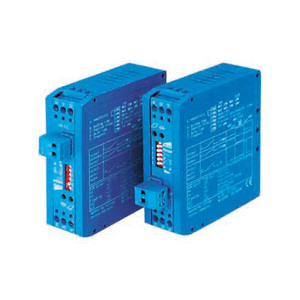
An inductive loop sensor circuit consists of two distinct components: an insulated wire loop embedded horizontally into saw-cut slots in the roadway pavement, and an electronic detector amplifier housed inside an adjacent NEMA or Model 332 traffic signal control cabinet. The detector energizes the loop wire with an AC signal operating in the frequency range of 20 kHz to 140 kHz, creating a localized high-frequency magnetic field above the pavement.
When a vehicle enters this magnetic field, Eddy currents are induced within the vehicle’s metallic structure (chassis, engine block, frame). These Eddy currents create an opposing magnetic field, effectively decreasing the net inductance ($L$) of the pavement loop. As loop inductance decreases, the LC tank circuit’s natural frequency increases according to the formula:
$$f_r = \frac{1}{2\pi \sqrt{L \cdot C}}$$
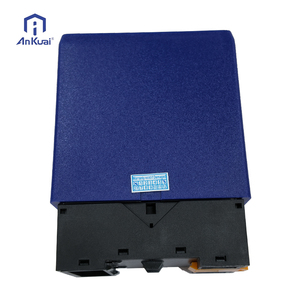
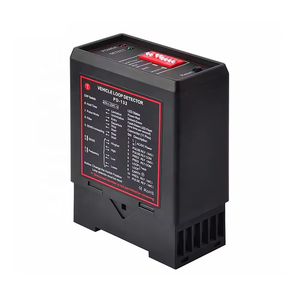
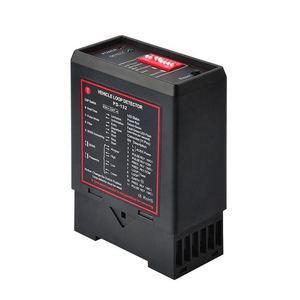
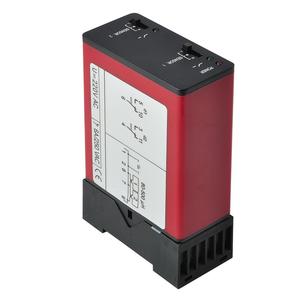
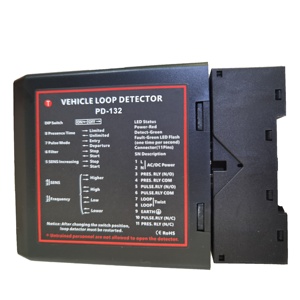
High-performance detector modules like the PD132 and AK-TL002 utilize high-speed digital microcontrollers to continuously sample this frequency shift. By evaluating both the magnitude ($\Delta f$) and duration of frequency changes, the amplifier distinguishes between passenger sedans, high-clearance delivery trucks, motorcycles, and ambient electromagnetic noise.
2. Greater Boston Environmental Stressors & Equipment Resilience
Supplying traffic and parking access control systems to Boston, Massachusetts requires addressing specific regional environmental conditions that frequently destroy standard off-the-shelf sensors:
❄️
Freeze-Thaw Pavement Stress
Boston’s winter severe freeze-thaw cycles cause sub-base ground heave, cracking asphalt along saw cuts. Our detectors feature broad automatic frequency tracking (drift compensation) to maintain calibration despite shifting loop geometry.
🧂
Calcium Chloride & Salt Fog
Road de-icing chemicals and coastal maritime salt air seep into pavement micro-fissures. Our loop detectors incorporate high-isolation input transformers to prevent dielectric breakdown and ground faults.
🚜
Snowplow Mechanical Abrasion
Heavy municipal plowing damages shallow embedded wires. For sites vulnerable to plow scraping, our 79GHz Millimeter Wave Radars offer a 100% surface-mounted non-intrusive alternative.
3. Localized Application Scenarios Across Boston Infrastructure
A. Logan International Airport Parking & Rental Car Center (ConRAC)
High-volume commercial parking decks require immediate, zero-latency detection to manage ticket dispenser triggering, vehicle counting, and barrier gate operation. Integrating single-channel PD132 detectors with short pulse mode ensures precise vehicle separation, preventing tailgating and ticket fraud while supporting fast flow rates during peak travel hours.
B. MBTA Transit Signal Priority (TSP) & Urban Arterials
Along major bus transit lanes (such as the Silver Line and key MBTA bus routes crossing Storrow Drive and Commonwealth Avenue), dual-channel loop detectors provide inputs to traffic controllers to extend green light phases for arriving transit vehicles. High sensitivity settings detect aluminum-bodied electric buses and emergency vehicles without delay.
C. Commercial Logistics Parks & Industrial Gate Access
Freight hubs operating around the Port of Boston and distribution centers along I-95/I-90 encounter a wide spectrum of vehicle chassis heights. Our loop amplifiers feature Automatic Sensitivity Boost (ASB), which dynamically increases gain during vehicle detection to prevent gate closure while long multi-axle trailers pass over the loop.
5. Emerging Procurement Trends in Greater Boston & New England
As MassDOT and local municipal public works departments move toward Vision Zero goals and modernized Intelligent Transportation Infrastructure, three distinct procurement trends have emerged:
Transition to Non-Intrusive Radar Sensing: Urban civil contractors are increasingly specifying 79GHz millimeter-wave radar modules to replace cut wires on historic streets (such as Beacon Hill or North End), preserving paving integrity while cutting installation labor costs by up to 70%.
Hybrid Redundancy Systems: High-traffic commercial garages are deploying hybrid arrays—combining an embedded PD132 loop detector for primary vehicle presence verification with a 79GHz anti-smash radar for pedestrian distinction and overhead barrier protection.
Surge & Environmental Hardening Standards: Due to heavy electrical transients caused by coastal lighting and grid fluctuations, engineers demand transformer-isolated inputs, wide operational voltage tolerances (±10%), and IP67 weather sealing.
Local Procurement & Technical Support
Boston Contractor & Engineer FAQs
Direct technical guidance from our vehicle detection engineering team on common installation and sourcing questions.
Q1: How do your loop detectors handle severe Boston winter freeze-thaw cycles without miscalibration?
Our loop amplifiers feature built-in microprocessor digital drift compensation. As temperature swings alter the physical dimensions of pavement saw-cuts and shift baseline loop inductance, the detector automatically tracks environmental baseline shifts without triggering false presence outputs.
Q2: Can we replace damaged cut-wire ground loops with your 79GHz millimeter wave radars?
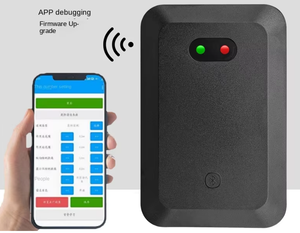
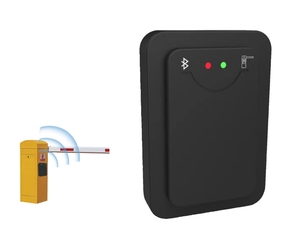
Yes. The 79GHz radar detector mounts directly onto the barrier housing or vertical post. It serves as a direct drop-in replacement for traditional loops, outputting standard relay signals to open barrier gates or prevent gate drop on vehicles and pedestrians without requiring asphalt trenching.
Q3: How do your detectors eliminate mutual interference (crosstalk) when multiple loops are installed close together?
All our multi-frequency loop detectors (including the PD132 and AK-TL002 series) feature selectable DIP switches that allow engineers to set distinct operating frequencies for adjacent loops. This prevents magnetic coupling and crosstalk between entry and exit loops sharing the same lane.
Q4: What is the recommended loop wire gauge and sealant for New England paving conditions?
We recommend using AWG 16 or AWG 14 cross-linked polyethylene (XLPE) insulated multi-strand copper wire paired with flexible elastomeric or polyurethane saw-cut sealants. This combination resists moisture penetration, salt water intrusion, and pavement shifting down to -40°C.
Q5: Are your detectors compatible with standard NEMA TS2, Model 170, and 2070 traffic control cabinets?
Yes. Our detector modules conform to standard 11-pin industrial socket configurations and DIN-rail mount requirements. They integrate seamlessly with standard North American traffic cabinet backplanes, barrier controllers, and commercial parking management systems.
Q6: What is the export delivery lead time to the Port of Boston or US East Coast distributors?
Standard product orders ship from our ISO-certified facility within 2 to 3 weeks. We provide complete sea and air export documentation—including HS code classifications, Certificate of Origin (COO), CE declarations, and pre-dispatch photometric/electrical test reports—to clear US Customs efficiently.
Why Global Infrastructure Procurement Teams Partner With Us
Backed by over 30 years of specialized manufacturing experience, our ISO 9001:2015, ISO 14001:2015, and ISO 45001:2018 certified 29,000+ sq ft facility produces dependable road safety hardware engineered for extreme reliability.
⚙️
In-House SMT Assembly & R&D
From microcontroller firmware design to surface-mount technology (SMT) electronics assembly, every circuit board is manufactured in-house without reliance on third-party black-box modules.
🧪
100% Quality Burn-In & IP Testing
Every detector batch undergoes strict thermal stress testing, high-voltage isolation verification, and IP65/IP67 ingress testing prior to export packing.
📄
Auditable Documentation
We supply full English engineering schematics, wiring diagrams, product test certificates, and photo-verified packing reports with every export consignment.
Ready to Upgrade Your Traffic & Parking Detection Systems?
Connect with our technical export engineers to request full product datasheets, wiring schematics, or factory-direct pricing for your Boston infrastructure project.