Engineering Precision Signal Lenses: An Industrial Whitepaper & Manufacturing Guide
In modern Intelligent Transportation Systems (ITS) and municipal road safety infrastructure, the optical efficiency and environmental durability of a signal lens dictate operational safety. Signal lenses are not mere protective polymer covers; they are precise optical instruments engineered to collimate light, manage photometric beam distribution, eliminate phantom light reflections, and resist severe atmospheric degradations such as ultraviolet (UV) radiation, thermal cycling, and chemical exposure.
As a premiere China Signal Lens Manufacturer & Factory operating out of advanced ISO-certified facilities, our organization integrates custom optical engineering, SMT electronics mounting, thermal shock testing, and high-precision injection molding under one roof. This whitepaper analyzes the material science, optical engineering standards, future procurement benchmarks, and manufacturing protocols governing world-class signal lenses for traffic signals, industrial indicators, emergency beacons, and warning lights.
1. Optical Engineering Fundamentals: Fresnel Collimation & Uniform Luminance
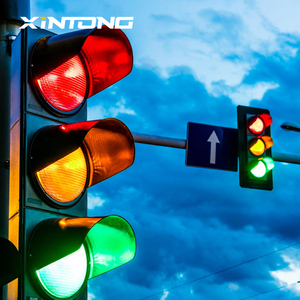
The primary challenge in traffic signal optic design is transferring light emitted from point-source SMT LEDs into a uniform, high-intensity beam compliant with international standards such as EN 12368 Class 1 and Class 2, as well as ITE VTCSH (Institute of Transportation Engineers) specifications. Standard convex or plano lenses exhibit significant spherical aberration, resulting in center hotspotting and diminished peripheral visibility.
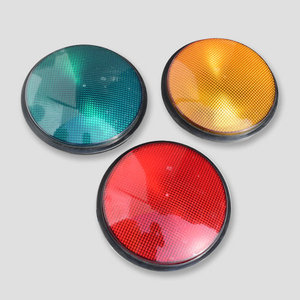
Our engineering team solves this through multi-tiered Fresnel Lens Micro-Structures and Total Internal Reflection (TIR) geometry. By molding concentric micro-prisms onto the internal surface of the polycarbonate lens, light rays emitted at wider angles are refracted parallel to the optical axis. This achieves:
- Luminous Efficiency Optimization: Photometric transmission efficiency exceeds 92.4%, allowing lower wattage LED arrays (e.g., 7W–12W per 300mm aspect) to yield luminous intensities exceeding 400 to 800 candelas.
- Elimination of Phantom Light (Sun Phantom): Direct sunlight entering a signal lens can bounce off internal reflectors, producing a false "ON" signal (Class 5 phantom level). Our proprietary black-matrix masking and micro-louver lens geometry direct ambient sunlight downward, ensuring absolute optical distinction between active illumination and passive reflection.
- Homogeneous Color Distribution: Chromaticity coordinates are rigidly fixed within the CIE 1931 color space for Red, Yellow (Amber), Green, and White signal spectrums, eliminating color shifting even after prolonged operational lifespans.
2. Material Science Matrix: Polycarbonate (PC) vs. Acrylic (PMMA) vs. Glass
Selecting the optimal polymer matrix is critical for long-term outdoor endurance. Below is a comparative breakdown of optical materials utilized in industrial signal lens fabrication:
| Physical / Optical Property | Optical Polycarbonate (Bayer Makrolon 2805) | PMMA Acrylic | Tempered Optical Glass |
|---|---|---|---|
| Impact Resistance (Charpy Notch, kJ/m²) | 75 – 85 (Virtually Unbreakable) | 2.0 – 2.5 (Brittle) | 1.0 – 1.5 (Shatters) |
| Light Transmission Efficiency (%) | 89% – 93% (With Anti-Reflective Coating) | 92% – 93% | 90% – 91% |
| Heat Deflection Temp (HDT @ 1.8 MPa) | 130°C – 145°C | 90°C – 100°C | > 500°C |
| UV Yellowing Index (Delta YI 10 Years) | < 1.5 (With Co-Extruded UV Stabilizers) | < 1.0 | 0.0 |
| Flame Retardancy Rating (UL 94) | V-0 / V-2 Self-Extinguishing | HB (Combustible) | Non-Combustible |
| Vibration & Thermal Shock Tolerance | Exceptional (MIL-STD-810G Grade) | Moderate | Poor |
Our OEM manufacturing lines predominantly utilize UV-stabilized virgin optical Polycarbonate (PC) resin supplied by world-leading chemical suppliers (such as Covestro Makrolon or SABIC Lexan). By co-extruding a 50-micron UV blocking layer, our signal lenses withstand continuous exposure to extreme ambient solar radiation without yellowing, crazing, or loss of mechanical impact strength.
3. Structural Integration & Weatherproof Seal Engineering
A signal lens must maintain structural integrity under harsh atmospheric conditions, including tropical rainstorms, freezing blizzards, salt-spray coastal atmospheres, and extreme desert heat swings (-40°C to +80°C). Ingress protection failure leads to moisture condensation inside the optical chamber, causing mirror corrosion, SMT short-circuiting, and drastic light attenuation.
Double-Lip EPDM Gaskets
Integrated continuous injection-molded EPDM or silicone seals guarantee IP65 to IP68 water and dust tight seals, preventing dust accumulation on inner optical prisms.
Sonic & Laser Welding
For modular signal aspects and industrial indicators, we deploy ultrasonic poly-welding to fuse the outer PC lens directly to the rear housing, creating a seamless, hermetically sealed optical core.
Hydrophobic Surface Nano-Coatings
Optional nano-scale surface treatments reduce water droplet bead angle, ensuring rain runoff clears dirt particles rapidly (self-cleaning property) to preserve lumen output in rainy climates.
4. Future Procurement Trends for Signal Lenses & Traffic Modules (2025–2030)
Global municipal authorities, highway construction contractors, and industrial procurement agencies are upgrading legacy lighting to smart, energy-efficient signal networks. Procurement managers should align their RFP (Request for Proposal) criteria with these emerging technological trends:
- Micro-Prismatic Dynamic Beam Shaping: Next-generation signal lenses incorporate asymmetrical lens geometry designed to throw light specifically into vehicle lane corridors while minimizing unwanted light spill into adjacent residential buildings.
- Integration with Smart V2X (Vehicle-to-Everything): Signal modules are transitioning into multi-sensor hubs. Lenses are now engineered to allow seamless transmission of Infrared (IR) signals and optical camera sensors embedded behind the lens shield.
- Recycled High-Grade Polymer Circularity: In alignment with international carbon-neutral procurement policies, top China signal lens factories are introducing certified post-industrial recycled PC resin blends that retain 98%+ of optical clarity while reducing embodied carbon emissions by 40%.
- Wide-Voltage Universal Driver Compatibility: Signal assemblies are increasingly standardized on universal AC 100-277V or DC 12-24V power platforms, enabling global deployment across different electrical infrastructure grids without redesigning housing or lens dimensions.
5. Strategic Advantage of Partnering with a Premier Chinese Manufacturer
Selecting the right OEM/ODM factory in China guarantees structural supply chain resiliency, rigorous quality assurance, and superior cost-to-performance metrics. Our facility in China stands out through:
- In-House Tooling & Precision Injection Molding: Operating over 30 high-tonnage CNC injection molding machines capable of maintaining micro-inch optical surface tolerances on lens molds.
- Full Photometric & Environmental Testing Laboratory: Every batch is tested using integrating spheres, goniophotometers, QUV accelerated weathering chambers, drop test rigs, and high-pressure water spray booths.
- Rapid Tooling for Custom OEM Specifications: We take custom lens projects from initial CAD/optical simulation (Zemax/LightTools) to physical prototype sample within 14 business days.