Featured Traffic Safety & Signal Management Solutions

Engineering Principles & Elastomer Science in Speed Bumps
Vulcanized SBR Rubber vs. Thermoplastic Polyurethane
Modern traffic speed bumps demand superior elastomeric memory to absorb repeated compression loads without permanent deformation. Our direct factory formulation utilizes virgin natural rubber blended with high-density Styrene-Butadiene Rubber (SBR). This yields a Shore A hardness rating of 75° to 85°, providing optimal impact dampening while preventing asphalt surface damage under 100-ton axle loads.
CE & EN 1436 Photometric retroreflection
Nighttime visibility is a key safety metric mandated by European standards (EN 1436). Our speed bumps incorporate high-index glass bead retroreflective elements embedded directly into molded yellow polyurethane strips. With luminance co-efficients exceeding 300 mcd/lux/m², drivers receive visual warnings at distances exceeding 250 meters under high-beam illumination.
Modular Interlocking & Structural Cable Channels
Integrated dual or quad bottom channels perform two vital functions: acting as surface drainage conduits to prevent hydrostatic pressure build-up underneath the bump, and serving as protective raceways for temporary or permanent utility cables, power lines, and fiber optic feeds across heavy traffic lanes.
Material Benchmark: Speed Bump Performance
| Performance Criterion | Vulcanized Heavy-Duty Rubber | Polyurethane (PU) Rigid | Cast Steel / Iron | Recycled Plastic Scrap |
|---|---|---|---|---|
| Axle Load Capacity | Up to 100 Tons | Up to 60 Tons | 150+ Tons | 15-20 Tons |
| Impact Sound Absorption | High (-15dB Noise) | Moderate (-8dB) | Poor (High Metallic Noise) | Low (-3dB) |
| UV & Weather Degradation | Anti-Ozone / 10+ Yrs | UV Stabilized / 8+ Yrs | Requires Painting / Rusting | Brittle after 2-3 Yrs |
| Tensile Strength (MPa) | 14.5 – 18.0 MPa | 22.0 – 28.0 MPa | 250+ MPa | 6.0 – 9.0 MPa |
| Asphalt Surface Damage Risk | Negligible (Flexible) | Low | High Road Cracking | Moderate |
State-of-the-Art Direct Factory Production
In-House Vulcanization & Hydraulic Compression Presses
Our facility features high-tonnage multi-daylight hydraulic vulcanization presses capable of precise temperature and pressure profiling. This guarantees uniform cross-linking density throughout each rubber module, eliminating internal air pockets, micro-cracks, and structural delamination under heavy commercial truck impacts.
Rigorous Photometric & Ingress Quality Laboratory
Every batch of speed bumps, embedded LED blinkers, and warning beacons undergoes continuous quality auditing. We execute IP68 water immersion testing, salt spray corrosion tests for anchor bolts, accelerated UV weathering inside environmental chambers, and photometric intensity verifications prior to container loading.
Future Procurement Trends in Speed Bump Technology
1. Integration of Active Solar & IoT Speed Warning Beacons
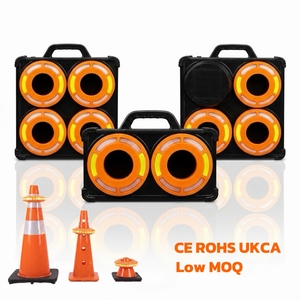
Municipal agencies are rapidly shifting from passive rubber bumps to active hybrid speed control zones. Future-proof procurement tenders specify modular rubber speed humps equipped with integrated solar-powered LED studs, dynamic Doppler radar speed displays, and synchronized flashing warning beacons (such as our CE-certified strobe series) to alert drivers at night before physical contact.
2. Bio-Based Elastomers & Circular Economy Mandates
With global ESG initiatives gaining traction in infrastructure contracting, European and North American importers require Environmental Product Declarations (EPD). Production lines are adopting devulcanized tire rubber scrap recombined with bio-based polyols, reducing carbon footprints by up to 45% without sacrificing tensile strength or tear resistance.
3. Variable-Viscosity Dynamic Speed Bumps
Next-generation smart bumps utilize non-Newtonian fluid cores or magnetorheological fluids. At compliant speeds (below 30 km/h), the fluid flows smoothly, allowing vehicle tires to pass with minimal bump impact. At excessive speeds, the fluid instantly hardens, enforcing speed reduction. Direct factories are pioneering hybrid rubber enclosures designed to house these fluid inserts.
4. Heavy EV Vehicle Weight Adaptations
The rapid adoption of electric passenger and commercial vehicles has increased average curb weights by 20% to 35%. Consequently, legacy plastic bumps deform prematurely under repeated heavy battery-pack wheel loads. Future procurement standardizes on reinforced vulcanized SBR with inner steel-plate bushings and high-tensile anchor bolt housings.