CE Certified Signal & Street Light Pole Catalog
Precision-engineered structural support systems manufactured for high-speed highways, smart urban junctions, and industrial infrastructure.
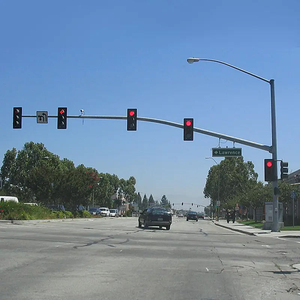
Standard Traffic Light Signal Pole with HD CCTV Camera & Aluminum Road Sign Board
- Dual cantilever bracket for camera & aspect
- Marine-grade anodized aluminum sign board
- ISO 1461 hot-dip galvanized steel core
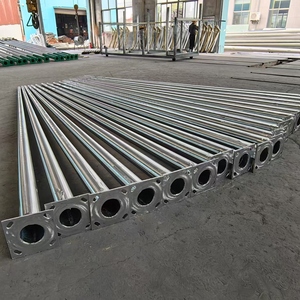
Customized Outdoor 4m 5m 6m 7m 8m 9m 10m 12m Double Single Arm Price Galvanized Steel Solar Street Light Pole Post Lamp Pole
- Custom heights from 4m up to 12m
- Octagonal or conical tapered profiles
- Dual-arm PV solar mounting flange
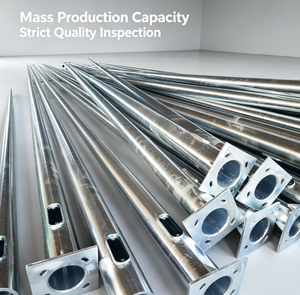
Galvanized Traffic Signal Pole, Conical Road Traffic Light Pole, Q235 Steel Signal Lamp Post With Flange Base
- High-tensile Q235 / Q355 structural steel
- Robotic submerged arc welding (SAW)
- Pre-drilled anchor bolt pattern flange

HUAFULAI Outdoor 4m 5m 6m 7m 8m 9m 10m 12m Double Single Arm Price Galvanized Steel Solar Street Light Pole Post Lamp Pole
- Heavy-duty corrosion protection
- Integrated lower access handhole
- Vibration-resistant structural dampening
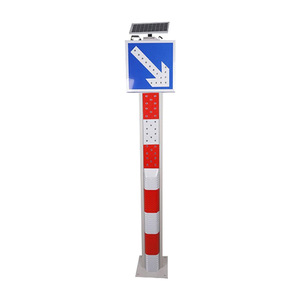
Aluminum Alloy Solar Intelligent Traffic Signal Light Pole Warning Post Flashing Lamp Pile with Lithium Battery
- Lightweight extrusion aluminum 6063-T6
- Built-in LiFePO4 battery compartment
- Autonomous dusk-to-dawn solar driver
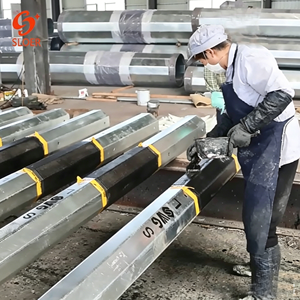
SLOER 10m 11m 15m 18m 20m 25m 20FT Galvanized Steel Polygonal Octagonal Mono Tower Utility Power Electric Pole
- High-mast utility polygonal geometry
- Heights spanning 10 meters to 25 meters
- Extreme wind shear load rating (180 km/h)
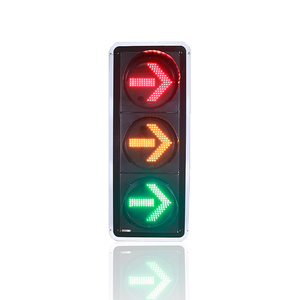
New Arrived Traffic Light Poles Allow Signal Lamp Led Solar Traffic Warning Light 300mm 400mm
- Supports 300mm & 400mm high-lux aspects
- Multi-angle horizontal adjustment arm
- IP65 weather-sealed wiring cavity
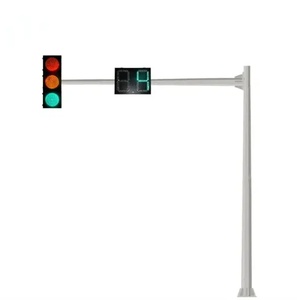
Traffic Signal Light Pole Arrow Countdown Timer Led Traffic Passage Light with Pole
- Integrated numeric countdown timer module
- Dual-row directional LED arrow indicators
- RS485 smart controller interface
1. Technical Blueprint: Engineering CE Certified Signal Poles for High-Reliability Infrastructure
Modern Intelligent Transportation Systems (ITS) and municipal intersection management demand uncompromised structural integrity from signal pole assemblies. A traffic signal pole is not merely a static structural post; it is a dynamic cantilever system subject to continuous fatigue, cyclic wind-induced loading, harmonic oscillations, and harsh atmospheric exposure. When procuring from CE certified signal pole factories, civil infrastructure consultants and EPC contractors must evaluate manufacturing facilities based on strict adherence to European Norms (EN 40-5, EN 1090-1), structural mechanics, and metallurgical processing standards.
1.1 Steel Grade Selection & Chemical Composition Control
The foundation of structural integrity lies in raw material selection. Premium factories employ prime-grade hot-rolled structural steel plates complying with EN 10025 standards (specifically S235JR, S355JR, S355J2+N) or international equivalents such as ASTM A572 Grade 50 and GB/T Q235B/Q355B.
To ensure optimal hot-dip galvanization without triggering the infamous "Sandelin Effect"—which causes brittle, overly thick, and poorly adhering zinc-iron alloy layers—leading factories strictly monitor the chemical silicon (Si) and phosphorus (P) indices of the base steel:
- Silicon Content: Kept either below 0.04% or within the strict range of 0.15% to 0.25%.
- Phosphorus Content: Controlled below 0.02% to prevent micro-cracking during thermal expansion in molten zinc baths.
- Tensile Yield Strength: Verified via chemical heat certificates (EN 10204 3.1) ensuring yield strength $\sigma_y \ge 355 \text{ MPa}$ for high-mast cantilever configurations.
1.2 Precision Forming, Taper Geometry & Welding Integrity
Modern signal poles are fabricated as conical, octagonal, or dodecagonal (12-sided) tapered hollow sections. The polygonal geometry dramatically improves the section modulus ($Z_x$) and torsional rigidity compared to traditional round pipes of equal wall thickness.
| Structural Parameter | Standard Conical Pole | High-Mast Octagonal Pole | Smart City Cantilever Mast Arm |
|---|---|---|---|
| Typical Height / Reach | 4.0m – 8.0m Vertical | 10.0m – 25.0m High Mast | 6.0m – 12.0m Arm Extension |
| Steel Grade | Q235B / S235JR | Q355B / S355JR | Q355J2+N High Yield |
| Wall Thickness | 3.0mm – 4.5mm | 5.0mm – 8.0mm | 4.0mm – 6.0mm Tapered |
| Galvanizing Spec | ISO 1461 (>85 µm) | ISO 1461 (>100 µm) | Dual-layer Duplex Coating |
| Wind Velocity Resistance | 140 km/h (38.8 m/s) | 180 km/h (50.0 m/s) | 160 km/h (44.4 m/s) |
| Welding Quality Audit | ISO 3834-2 / AWS D1.1 | NDT Ultrasonic & Magnetic | 100% Full Penetration Circumferential |
Welding execution must conform to EN ISO 3834-2 certification. Continuous longitudinal seams are executed using automated Submerged Arc Welding (SAW) or Robotic Gas Metal Arc Welding (GMAW). Crucially, the connection between the base flange plate and the pole shaft utilizes a double-fillet or full-penetration groove weld subjected to Non-Destructive Testing (NDT) via Ultrasonic Testing (UT) and Magnetic Particle Inspection (MPI) to eliminate micro-voids and fatigue stress concentrators.
2. Corrosion Protection Metallurgy: ISO 1461 Hot-Dip Galvanizing & Duplex Coatings
Signal poles installed along coastal expressways, urban intersections exposed to de-icing salts, or high-humidity tropical zones face aggressive atmospheric corrosion. ISO 9001 and CE-certified factories mandate a multi-stage hot-dip galvanizing process to guarantee a minimum service life of 30 to 50 years with zero maintenance.
Stage 1: Surface Pretreatment
Components undergo chemical degreasing, acid pickling in hydrochloric acid (HCl) baths to remove mill scale and rust, followed by a rinsing stage and immersion in a zinc ammonium chloride fluxing tank at 65°C to prevent pre-oxidation.
Stage 2: Molten Zinc Bath Immersion
Poles are fully submerged in a molten zinc kettle maintained at 445°C–455°C. Metallurgical diffusion creates four distinct iron-zinc alloy layers (Eta, Zeta, Delta, Gamma), producing a total coating thickness ranging from 86 µm to over 120 µm, exceeding ISO 1461 requirements.
Stage 3: Duplex Thermoset Powder Coating
For municipal aesthetics and aggressive chemical environments, an electrostatically applied architectural-grade polyester powder coating (RAL color spectrum) is cured at 200°C over the sweep-blasted galvanized surface, providing synergistic UV and salt-spray protection (>1500 hrs ASTM B117).
3. Enterprise Manufacturing Superiority & Factory Direct Capabilities
Building upon over 30 years of industrial expertise since 1992, our integrated 29,000+ sq. ft ISO-certified manufacturing facility in MIDC Bhosari, Pune represents the pinnacle of traffic signal hardware production. Operating under audited ISO 9001:2015 (Quality), ISO 14001:2015 (Environmental), and ISO 45001:2018 (Safety) frameworks, we offer direct enterprise advantages to overseas distributors, EPC contractors, and municipal authorities.
3.1 In-House R&D, Electronics SMT & Photometric Testing
Unlike simple structural assembly shops, our factory integrates mechanical pole fabrication directly with optical and electronic signal assembly. Our facility houses:
- High-Speed SMT Lines: Precision Surface Mount Technology for populating LED driver circuits with integrated surge protection (up to 10kV) and constant-current regulation.
- Darkroom Photometric Lab: Automated goniophotometer testing verifying luminous intensity distributions (cd/m²) in compliance with EN 12368 Class III and ITE specifications.
- IP65 Ingress & Environmental Test Chambers: Vacuum water jet testing and thermal shock chambers (-40°C to +80°C) ensuring complete weatherproofing of pole handhole access panels and signal aspect housings.
3.2 Comprehensive Documented Quality Assurance for International Tenders
Every dispatch batch is backed by a full Quality Assurance Dossier certified by our quality control engineers. Overseas buyers receive complete compliance documentation, including:
- Mill Test Certificates (EN 10204 3.1): Full heat numbers and chemical analysis of raw structural steel.
- Galvanizing Thickness Reports: Magnetic gauge verification reports confirming minimum coating thickness across pole shaft, arms, and base flange.
- Photometric & Electrical Safety Test Certificates: Insulation resistance (>100 MΩ), high-voltage withstand tests, and optical output validation.
- Detailed GA & Structural Calculations: CAD Shop drawings, foundation bolt sizing, anchor plate stress analysis, and wiring schematics supplied in English.
4. Future Sourcing Trends: The Evolution of Intelligent & Sustainable Signal Poles
As urban mobility transitions toward Smart Cities, Cooperative Intelligent Transport Systems (C-ITS), and Autonomous Vehicle frameworks, signal pole procurement requirements are rapidly shifting. Infrastructure planners must future-proof their supply chains by adopting multi-functional pole architectures.
4.1 Multi-Sensor & 5G Smart Pole Integration
Modern signal poles are evolving into integrated IoT hubs. Future-ready designs feature internal cable raceways, high-density power buses, and standardized mounting brackets for 5G micro-cells, Doppler radar speed sensors, ANPR surveillance cameras, environmental air quality monitors, and edge-computing AI signal controllers.
4.2 Autonomous Solar-PV & Off-Grid Hybridization
To reduce municipal power grid dependency and ensure zero downtime during grid failures, signal poles increasingly incorporate integrated flexible solar panels, MPPT charge controllers, and tamper-proof base-housed LiFePO4 battery banks capable of providing 3-5 days of continuous power autonomy.
4.3 Passive Safety & Passive Crash Breakaway Bases
Conforming to EN 12767 standards, highway departments are prioritizing passive safety signal poles. Engineered with shear-pin slip bases or impact-deforming base couplings, these poles detach or yield upon vehicle impact, drastically reducing fatality risks for vehicle occupants on high-speed roadways.
5. Procurement FAQ: Expert Guidance for Tender & Engineering Teams
Below are authoritative technical answers to common questions encountered by B2B buyers, municipal consultants, and international importers when specifying CE certified signal poles.
Partner with a Certified Traffic Signal Pole Manufacturer
Need engineered CAD drawings, certified wind load calculations, or a competitive factory-direct quote for your upcoming tender? Connect with our senior engineering team today.