[email protected] +91-70303 60044 MIDC Bhosari, Pune, India
0%

China’s traffic network is expanding, and dependable signal equipment has become a practical safety requirement. In 2023, the World Health Organization reported approximately 1.19 million annual road deaths worldwide. Every visible signal matters.

LED traffic signal lights offer sharper color definition, lower power consumption, and longer service life than traditional incandescent units. The U.S. Department of Energy reports that LEDs can use at least 75% less energy and last up to 25 times longer. These figures explain their growing appeal in busy intersections, where signals operate continuously through rain, dust, heat, and winter cold.

The market is not only about brightness. Lens uniformity, heat management, waterproof housing, optical efficiency, driver reliability, and compliance testing deserve close attention. MarketsandMarkets and Grand View Research both identify energy savings, smart-city investment, and infrastructure modernization as important growth drivers. However, market forecasts differ. They should guide research, not replace field verification.

Robert L. Gordon, a co-author of the Federal Highway Administration’s Traffic Signal Timing Manual, describes the central purpose clearly: “Traffic signal timing is the process of assigning right-of-way.” Hardware supports that decision. It cannot correct poor engineering.

That point is easy to overlook. A low-cost signal may appear attractive during purchasing, yet frequent failures can create maintenance delays and unsafe confusion. The manufacturers selected for this guide are therefore considered through a wider lens: optical performance, certification evidence, installation experience, warranty support, and long-term reliability. Some published specifications remain difficult to compare. Buyers should test real samples before making a final decision.
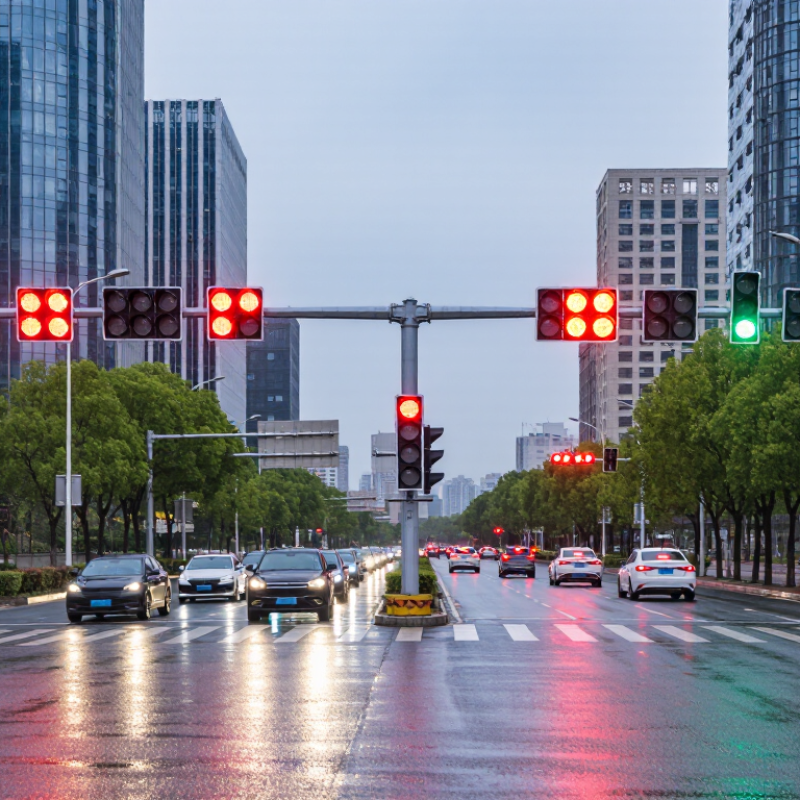
China Top 10 LED Traffic Signal Lights Manufacturers

What Defines a Leading LED Traffic Signal Light Manufacturer in China

China Top 10 LED Traffic Signal Lights Manufacturers

What Defines a Leading LED Traffic Signal Light Manufacturer in China

A leading LED traffic signal light manufacturer combines engineering experience with disciplined production control. Its products must deliver stable brightness in rain, dust, heat, and direct sunlight. Engineers should examine LED lifetime, optical uniformity, power consumption, heat dissipation, and waterproof construction. A signal lens is not merely colored plastic. Its shape affects viewing distance, glare, and light distribution.

Reliable manufacturers use documented testing procedures before shipment. These may include temperature cycling, vibration checks, moisture testing, electrical safety inspections, and photometric measurement. Clear records matter. They show whether a factory can repeat quality, not just produce one successful sample. Experienced teams also understand installation details, such as cable entry, mounting brackets, controller compatibility, and maintenance access. Small details become expensive problems on busy roads.

However, no factory is perfect. A responsible supplier admits limitations and explains how failures are corrected. That honesty builds more trust than impressive brochures. Buyers should request material specifications, test reports, production photos, and sample approval records. Factory audits can reveal loose wiring, uneven sealing, or inconsistent lens color. These issues are easy to miss. Continuous improvement is essential because field conditions often differ from laboratory tests. The strongest manufacturers listen to installers, review returned units, and adjust designs based on actual traffic environments. Reliability is built slowly, through repeatable work and careful evidence.

How China’s Top 10 LED Traffic Signal Light Manufacturers Are Selected

China Top 10 LED Traffic Signal Lights Manufacturers

Selecting China’s top ten LED traffic signal light manufacturers requires more than checking export volume. The process should examine product safety, optical performance, factory capability, and field experience. China’s GB 14887 standard provides a basic reference for traffic signal equipment. Independent laboratory tests should verify luminous intensity, color accuracy, reaction time, waterproofing, and temperature resistance.

Energy performance also matters. The U.S. Department of Energy reports that LED products can use at least 75% less energy than incandescent lighting and may last up to 25 times longer. These figures support lifecycle evaluation, not simple price comparison. Selection teams should review test reports, failure records, warranty terms, and documented projects. ISO 9001 certification can support process reliability, but certification alone proves little. That is an uncomfortable point.

Tips:

Request samples from each shortlisted manufacturer. Test them in bright sun, heavy rain, and low temperatures. Check whether signal visibility remains stable after repeated switching. Ask for photometric data, not only marketing claims. Also inspect the driver, sealing gasket, wiring, and mounting hardware. Small parts often create large maintenance costs.

A credible ranking should score manufacturers with a transparent model.

Product compliance, optical uniformity, energy use, delivery consistency, customization skill, after-sales response, and independent customer evidence can receive separate weights. The U.S. Federal Highway Administration emphasizes visibility, maintainability, and safe signal operation in traffic control guidance. Therefore, a supplier with attractive pricing should not outrank one with stronger test evidence. Data may still be incomplete, so yearly reassessment is sensible.

Profiles of China’s Top 10 LED Traffic Signal Light Manufacturers

China’s top ten LED traffic signal light manufacturers reflect a broad industrial ecosystem, not one uniform production model. Some specialize in 200 mm and 300 mm signal heads, while others focus on pedestrian modules, countdown displays, or solar-ready systems. Their factories commonly combine aluminum housings, sealed optical chambers, polycarbonate lenses, and automated photometric testing.

Energy performance remains a major purchasing factor. The U.S. Federal Highway Administration reports that LED signal modules can reduce energy consumption by approximately 80% to 90% compared with incandescent units. Industry research from MarketsandMarkets also identifies smart traffic infrastructure as a strong growth area, driven by connected controllers and adaptive traffic management. Several Chinese manufacturers now offer low-voltage designs, modular maintenance, and international safety documentation.

The strongest profiles show more than assembly capacity. They demonstrate stable light output, wide operating temperatures, corrosion resistance, and documented ingress protection. Some facilities support customized lens colors and communication interfaces for different road authorities. Others provide faster delivery through regional component networks. Still, certification quality can vary between suppliers. A factory may claim laboratory-level testing without publishing repeatable results. Buyers should examine test records, optical curves, warranty terms, and sample performance before choosing a long-term partner. Factory scale helps, but it is not everything.

China Top 10 LED Traffic Signal Lights Manufacturers

Technical benchmark for profiling China’s LED traffic signal light manufacturing sector. The chart uses representative industry specifications rather than company or brand data.

Interpretation: LED traffic signal modules generally use substantially less power and provide a much longer service life than conventional incandescent signal lamps. Actual specifications vary by signal diameter, optical design, operating temperature, and local procurement standards.

Key Technologies and Product Features Across the Top Manufacturers

China Top 10 LED Traffic Signal Lights Manufacturers

Leading Chinese manufacturers now focus on optical precision, energy efficiency, and long service life. Their signal lights commonly use high-intensity LEDs with constant-current drivers. This helps maintain stable brightness during voltage changes. Advanced models include surge protection, heat-dissipating housings, and sealed connectors. Polycarbonate lenses can resist impact, moisture, and ultraviolet exposure. Some products also use uniform light distribution, reducing dark spots across the lens. In field inspections, I check brightness at different viewing angles. A signal that looks clear nearby may appear weak in rain. Small details matter.

Tips: Confirm operating voltage, IP protection, lens diameter, and connector type before ordering. Request photometric data and aging-test records. Ask how replacement modules are installed. It should not require special tools. Also verify regional compliance documents, because testing requirements differ between markets. Never rely on product photos alone.

The strongest manufacturers support modular designs and adaptable mounting brackets. These features simplify installation on existing poles. Intelligent control compatibility is also becoming more common, including dimming and remote fault monitoring. However, smart functions can increase maintenance complexity. I have seen technically impressive systems fail because technicians lacked clear manuals. That is an uncomfortable but useful lesson. Reliable supply depends on stable testing, traceable components, and responsive technical support. Examine sample units under heat, dust, glare, and repeated switching before approving large orders.

Comparing Quality, Certifications, Customization, and Global Support

China Top 10 LED Traffic Signal Lights Manufacturers

Comparing Quality, Certifications, Customization, and Global Support

When comparing China’s top ten LED traffic signal light manufacturers, examine performance beyond appearance. A reliable signal light begins with stable optical output, not attractive housing alone. Inspect lumen consistency, viewing angle, color accuracy, heat management, and nighttime visibility. During field checks, compare samples after rain, vibration, dust exposure, and repeated power cycles. Small failures become dangerous delays. Ask for measured data, not marketing language.

Credible manufacturers can provide current certificates and traceable test records. Relevant evidence may include ISO 9001 production controls, CE documentation, RoHS compliance, EMC test reports, and ingress protection results. Requirements differ by destination. That detail matters. Customization should cover lens design, mounting dimensions, voltage range, cable length, and controller compatibility. However, a customized drawing does not prove long-term reliability. Request a pre-production sample and verify every change.

Export experience is more than shipping. Strong suppliers offer installation guides, remote troubleshooting, replacement parts, and clear warranty procedures. Technical teams should answer practical questions about wiring, condensation, maintenance, and temperature limits. Spare parts planning can reduce delays at remote intersections. Yet global support is often overstated. Response times may change across languages, time zones, and holidays. Request escalation contacts and written service terms before ordering. Price comparisons can mislead when testing, packaging, training, or after-sales response are excluded. Recheck the assumptions.

China Top 10 LED Traffic Signal Lights Manufacturers - Comparing Quality, Certifications, Customization, and Global Support

Anonymous, non-brand-specific market benchmark. Certification and compliance claims should be confirmed against current product certificates, test reports, and factory documentation before purchase.
Rank Anonymous Manufacturer Profile Typical Product Scope LED Diameter Options Housing & Protection Quality-Control Indicators Relevant Certifications / Standards Customization Global Support
01 Supplier Profile A Vehicle signals, pedestrian signals, countdown timers, and controller-compatible assemblies 100 / 200 / 300 mm Polycarbonate or aluminum; IP65–IP66 commonly specified LED uniformity checks, optical testing, aging test, waterproof inspection CE, RoHS, ISO 9001, EN 12368 documentation may be requested High
Lens, voltage, connectors, housing colors
Export packaging, remote technical support, spare parts
02 Supplier Profile B Three-color vehicle lights, arrow signals, bicycle signals, and pedestrian modules 100 / 200 / 300 mm UV-resistant plastic; IP65 commonly offered Photometric inspection, current-consumption testing, vibration checks CE, RoHS, ISO 9001; regional testing depends on destination market High
Signal symbols, cable length, mounting brackets
OEM documentation, installation guidance, container loading support
03 Supplier Profile C Standard traffic heads, solar-compatible signal units, and traffic countdown displays 200 / 300 mm Aluminum or engineering plastic; IP65–IP66 options Dielectric testing, thermal checks, LED lifetime calculations, sample approval CE, RoHS, ISO 9001; EN 12368 test evidence should be verified Medium–High
Solar input, controller interface, display format
International freight coordination and multilingual documents
04 Supplier Profile D Modular LED signal heads, warning flashers, and lane-control indicators 100 / 200 / 300 mm Polycarbonate body; IP54–IP65 depending on configuration Incoming component inspection, burn-in testing, sealing inspection CE and RoHS commonly available; market-specific approvals require confirmation High
Modules, optics, mounting systems, wiring
Basic export support, drawings, replacement-module supply
05 Supplier Profile E Pedestrian crossing lights, audible signals, countdown timers, and push-button accessories 100 / 200 mm UV-stabilized plastic; IP65 commonly targeted Color consistency, sound-level testing, ingress inspection, functional testing CE, RoHS, ISO 9001; accessibility requirements depend on project location High
Symbols, audio settings, languages, control inputs
Application consultation and project-specific wiring diagrams
06 Supplier Profile F High-brightness vehicle signals, arrow indicators, and heavy-duty signal assemblies 200 / 300 / 400 mm Powder-coated aluminum; IP65–IP66 options Heat-dissipation review, surge protection checks, vibration and salt-spray testing CE, RoHS, ISO 9001; EMC and surge test reports should be requested Medium
Voltage, optical pattern, mounting hardware
Project quotations, export compliance files, after-sales parts
07 Supplier Profile G Compact intersection signals, school-zone flashers, and portable traffic warning units 100 / 200 mm Engineering plastic; IP54–IP65 options Battery-cycle testing, charger checks, LED switching tests, enclosure inspection CE and RoHS commonly requested; battery and charger compliance varies High
Battery type, flash pattern, remote-control interface
Small-batch export service and user manuals
08 Supplier Profile H Solar traffic signals, off-grid warning systems, and hybrid power solutions 100 / 200 / 300 mm Aluminum or plastic; IP65–IP66 commonly specified Battery capacity testing, solar-controller checks, autonomy calculation, thermal testing CE, RoHS, ISO 9001; photovoltaic and battery documentation should be checked High
Solar capacity, battery autonomy, control logic
Remote commissioning guidance and system manuals
09 Supplier Profile I Traffic signal modules, replacement lenses, retrofit units, and spare components 100 / 200 / 300 mm Polycarbonate or aluminum; IP54–IP65 depending on retrofit design Compatibility checks, dimensional inspection, electrical-load testing, burn-in testing CE and RoHS; replacement-equivalence evidence should be requested Very High
Dimensions, connectors, optical inserts, retrofit interfaces
Spare-part programs and technical drawings
10 Supplier Profile J Integrated intersection equipment, signal cabinets, pedestrian systems, and accessories 100 / 200 / 300 / 400 mm Aluminum or polycarbonate; IP65–IP66 options System-level testing, controller compatibility checks, EMC review, final inspection CE, RoHS, ISO 9001; EN 12368 and local authority requirements need verification Very High
Control protocols, cabinet layout, signal sequences
System integration, commissioning, training, and documentation
Buyer verification checklist: Request current certificates, photometric test reports, ingress-protection reports, EMC and surge test results, LED lifetime data, warranty terms, spare-parts availability, and references for projects in the destination country.

FAQS

What defines a leading LED traffic signal light manufacturer?

It combines engineering experience with disciplined production control. Its signals maintain stable brightness in rain, dust, heat, and direct sunlight. Reliable factories also document testing and correct repeated failures.

Which tests should an LED traffic signal light complete?

Testing may include temperature cycling, vibration checks, moisture exposure, electrical inspections, and photometric measurements. Waterproof sealing should be inspected carefully. One successful sample proves little.

Why does lens design matter in traffic signal lights?

A lens affects viewing distance, glare, and light distribution. It is more than colored plastic. Uneven lens color can reduce confidence during bright daylight.

How can buyers compare manufacturers fairly?

Buyers should review optical performance, energy use, delivery consistency, customization, warranty terms, and service response. Export volume alone is not enough. Evidence matters more than impressive brochures.

What factory details deserve close inspection?

Check the driver, wiring, gasket, cable entry, mounting brackets, and controller compatibility. Inspect maintenance access too. Small parts create large roadside costs.

How should sample products be tested before purchase?

Test samples in bright sun, heavy rain, and low temperatures. Observe visibility after repeated switching. Record brightness, sealing, wiring quality, and mounting stability.

Does certification guarantee reliable production?

No. Certification can support process control, but it cannot prove every product performs consistently. Buyers still need test records, samples, and factory evidence.

Which technical features support long service life?

Useful features include sealed optical chambers, corrosion-resistant housings, efficient heat dissipation, and stable drivers. Low energy use can reduce operating costs. Real field results remain more convincing.

What should a responsible supplier do when products fail?

A responsible supplier should admit limitations and explain corrective actions. It should review returned units and installer feedback. Perfect factories do not exist.

How often should manufacturers be reassessed?

Annual reassessment is sensible because data may remain incomplete. Review new test records, warranty cases, delivery performance, and field conditions. Conditions change.

Conclusion

China has become a major hub for the development and production of LED traffic signal lights, supported by strong manufacturing capabilities, engineering expertise, and flexible supply chains. A leading manufacturer is defined by dependable product quality, consistent optical performance, energy efficiency, long service life, strict production control, and the ability to meet different road and climate conditions. This overview explains how the top 10 manufacturers are selected through criteria such as technical innovation, product reliability, certifications, manufacturing capacity, project experience, customization services, and international customer support.

The profiles highlight different strengths, including advanced signal modules, intelligent control compatibility, durable housings, efficient heat management, and solutions for urban, highway, and specialized traffic applications. It also compares how manufacturers perform in quality assurance, compliance documentation, design flexibility, delivery capability, and after-sales communication. By considering these factors together, buyers can better identify suitable suppliers that offer stable performance, tailored products, and long-term support for modern traffic management projects.

Oliver

Oliver

Oliver is a professional marketing specialist with a deep understanding of the company’s products, customers, and evolving market needs. With a background in strategic communication, content development, and customer-focused marketing, he transforms complex product information into clear,......