Choosing a junction traffic signal controller is not simply a matter of comparing prices or counting signal phases. It affects queue length, pedestrian safety, emergency access, power use, and daily travel reliability. Global buyers must examine local traffic patterns, cabinet compatibility, communication standards, weather resistance, and maintenance support before selecting equipment.
Dr. Brian Wolshon, a respected transportation engineer and professor, has emphasized this practical principle: “Good traffic control should make movement safer, clearer, and more predictable.” That idea matters at every junction, from a crowded Asian city intersection to a remote European road crossing. A controller should respond accurately when vehicles arrive unevenly, pedestrians request crossing time, or a power interruption affects operations.
This guide reviews seven leading junction traffic signal controller options for international buyers. The comparison considers adaptive control, coordination ability, detector support, cybersecurity features, installation demands, and lifecycle cost. Field experience shows that a technically advanced controller can still disappoint when software training is weak or spare parts arrive slowly. That is easy to overlook.
Look closely at the details. A clear cabinet layout helps technicians work during rain. Reliable diagnostics can reduce unnecessary site visits. Flexible timing plans support changing traffic conditions.
No single model fits every junction. Procurement teams should verify certifications, supplier references, local integration capability, and long-term service commitments. The best choice is not always the most expensive one. It is the controller that performs consistently, remains maintainable, and matches the road network’s real needs.
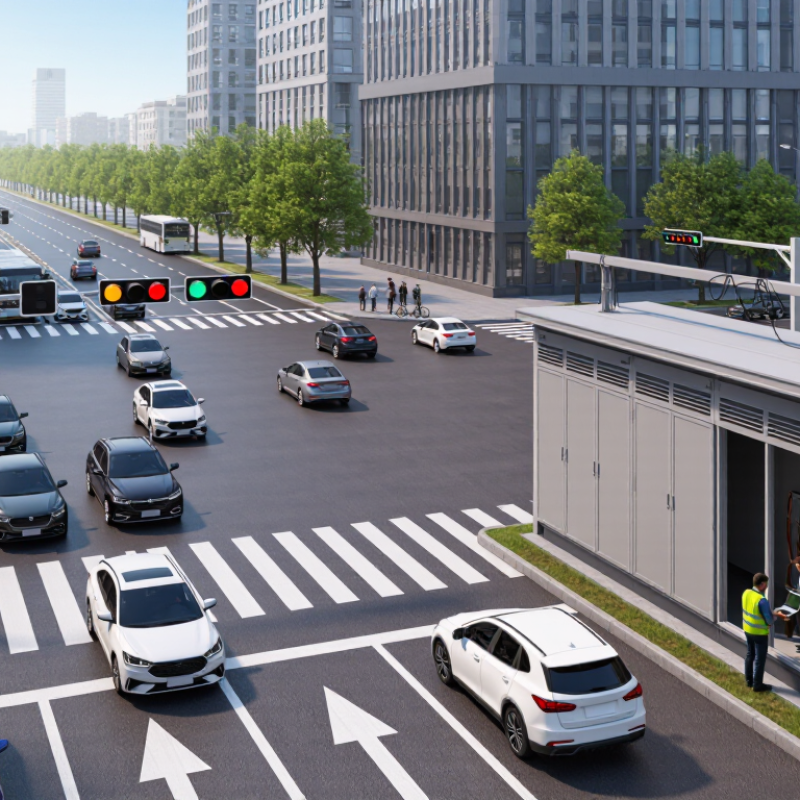
What Junction Traffic Signal Controllers Are and How They Work
Junction traffic signal controllers are roadside computers that assign green, amber, and red time to conflicting movements. They process detector, pedestrian, coordination, and safety inputs. The controller then selects a signal phase, checks minimum times, and prevents unsafe overlaps. It is the junction’s quiet decision-maker.
Seven controller approaches suit different roads: fixed-time, vehicle-actuated, semi-actuated, adaptive, coordinated, pedestrian-responsive, and priority-capable systems. Fixed-time control suits stable flows. Actuated control responds to waiting vehicles. Adaptive control recalculates timings from live traffic data. The Federal Highway Administration’s Traffic Signal Timing Manual explains these timing principles, while NTCIP 1202 supports standardized controller communications. Hardware alone does not create efficiency. Detector placement, cabinet temperature, power quality, and maintenance matter equally.
The need is serious. The WHO Global Status Report on Road Safety 2023 records about 1.19 million annual road traffic deaths worldwide. INRIX’s 2023 Global Traffic Scorecard reported 97 hours lost to congestion for the average United States driver. Better junction control cannot solve every delay, but it can reduce unnecessary stopping and improve crossing opportunities. Field commissioning should test queues, pedestrian clearance, emergency behavior, and communications failure. Imperfect assumptions remain dangerous. A controller may perform well in simulation, yet struggle during rain, unusual events, or detector faults. Global buyers should compare standards, response logic, local support, and lifecycle records—not screen specifications alone.
| Rank | Controller Type | Typical Junction Size | Signal Capacity | Typical Power Input | Detection Support | Communication | Environmental Protection | Best Use Case | How It Works |
|---|---|---|---|---|---|---|---|---|---|
| 1 | Advanced Adaptive Controller | Large urban junctions with multiple approaches | Up to 8 vehicle phases, pedestrian phases, and coordinated outputs | Typically 120 VAC or 230 VAC, 50/60 Hz | Inductive loops, video, radar, pedestrian push-buttons, and transit priority inputs | Ethernet, cellular, serial communication, and NTCIP-compatible interfaces where specified | Usually installed in a weather-resistant roadside cabinet; cabinet protection commonly IP54 or higher | Congested corridors requiring real-time traffic response | Uses detector data to adjust green times, offsets, and phase timing according to changing traffic demand. |
| 2 | Multi-Phase Coordinated Controller | Four-way intersections and arterial corridors | Typically 8 vehicle phases with separate pedestrian and overlap functions | Commonly 120 VAC, 60 Hz, or 230 VAC, 50 Hz | Loop detectors, video detection, radar, and manual pedestrian inputs | Time-base coordination, Ethernet, fiber, cellular, or RS-485 depending on configuration | Cabinet-based installation; typical operating range is approximately −30°C to +70°C with suitable thermal management | Coordinated signal networks and high-volume city roads | Runs stored timing plans and synchronizes cycle length, split, and offset with nearby intersections. |
| 3 | NEMA TS2-Style Controller | Standard North American urban and suburban junctions | Up to 8 vehicle phases with configurable overlaps and pedestrian service | Typically 120 VAC, 60 Hz | Detector rack inputs for loops, video systems, radar, and pedestrian buttons | Serial or Ethernet communication; NTCIP support may be included for central management | Installed in a traffic cabinet with surge protection and temperature-controlled ventilation where required | Intersections following North American traffic-control practices | Executes programmed phase sequences while monitoring detector calls, conflicts, and cabinet status. |
| 4 | European EN 12675-Style Controller | Compact and medium-sized junctions using European signal conventions | Commonly 4 to 8 vehicle phases with pedestrian and cyclist stages | Typically 230 VAC, 50 Hz | Vehicle detectors, pedestrian push-buttons, bicycle detection, and priority inputs | Ethernet, fiber, cellular, or wired serial links depending on the traffic-management system | Outdoor cabinet commonly rated IP54 or higher, with EMC and electrical safety provisions | European cities, roundabout approaches, and mixed pedestrian-cyclist corridors | Controls red, amber, and green outputs through safe phase transitions and programmed intergreen times. |
| 5 | Compact DIN-Rail Controller | Small intersections, private roads, campuses, and industrial sites | Typically 2 to 4 vehicle phases with limited expansion | 100–240 VAC, 50/60 Hz, or 24 VDC depending on the installation | Push-buttons, simple vehicle detectors, radar, and dry-contact inputs | USB, RS-485, Ethernet, or local programming interface | Requires installation inside a suitable enclosure; the module itself is commonly IP20 to IP30 | Low-volume roads where compact size and simple maintenance are priorities | Switches signal outputs according to a fixed schedule or basic detector calls without extensive network functions. |
| 6 | Solar or Low-Voltage Controller | Remote crossings, rural junctions, and locations with unreliable grid power | Usually 2 to 4 phases for low-demand traffic movements | 12 VDC or 24 VDC battery system, normally supported by solar charging | Radar, microwave, push-button, infrared, or low-power presence sensors | Low-power cellular, radio, or local wireless monitoring when required | Outdoor enclosure commonly IP65 or higher, with battery and charge-controller protection | Off-grid pedestrian crossings and remote low-volume junctions | Stores energy in batteries, operates signal phases at low voltage, and uses solar charging to reduce grid dependence. |
| 7 | Portable Temporary Traffic Controller | Work zones, emergency diversions, and temporary lane arrangements | Normally 2 to 4 phases with configurable all-red and clearance periods | Battery, 12/24 VDC, or 230 VAC depending on the temporary installation | Manual synchronization, radar, temporary loops, and wireless vehicle detection | Short-range radio, cable synchronization, cellular monitoring, or local setup | Portable weather-resistant housing, often targeted at IP54–IP65 protection | Road construction, bridge maintenance, and rapidly deployable traffic control | Uses synchronized timing plans or detector calls to alternate traffic movements safely through a restricted area. |
FAQS
It is a roadside computer.
A fixed-time controller usually suits predictable traffic flows.
Adaptive control recalculates timings using live traffic information.
Compare detector quality, cabinet temperature ratings, surge protection, and communication interfaces.
Prepare a written phase plan and label every terminal clearly.
It can process crossing requests and provide suitable clearance intervals.
The controller should use a safe fallback strategy and record the fault.
Clean the cabinet and inspect terminals, connections, batteries, and protective devices.
Start with vehicle counts, turning movements, pedestrian demand, weather, and emergency requirements.
Conclusion
A Junction traffic signal controller is the operational core of an intersection, coordinating signal phases, timing, pedestrian movements, vehicle detection, and priority functions to improve safety and traffic flow. This article explains how these controllers work and highlights the key features global buyers should evaluate, including processing capacity, communication options, detection support, fault monitoring, cybersecurity, weather resistance, and ease of configuration. It compares seven leading controller types according to performance, flexibility, expandability, installation needs, and total ownership considerations.
The guide also examines international standards, electrical compatibility, communications requirements, cabinet integration, and local deployment conditions that can affect project success. Buyers will learn how to select a controller based on intersection complexity, traffic patterns, environmental demands, and future upgrade plans. Practical advice on installation, testing, documentation, preventive maintenance, spare parts, and lifecycle management helps ensure reliable operation and consistent performance across different regions.